Select date

FIGHT CLUB (1999) – Marxist Mobs, Culture Wars & Shades Of 9/11


“Welcome to Fight Club. The first rule of Fight Club is: you do not talk about Fight Club.” – Fight Club by Chuck Palahniuk
John the Revelator
21st Century Wire
The 1999 film Fight Club is an exploration into the underbelly of radical social change in modern day America. Underneath the film’s anti-establishment veneer is a sardonic foray into Cultural Marxism, archetypal motifs, dissociative identity disorder and so much more.
The story of Fight Club is based on author Chuck Palahniuk’s 1996 novel, a transgressive-fictional account entrenched in anarchic nihilism, consumer culture and the pitfalls of a postmodern society. The darkly comedic psychological drama has achieved cult-like status by heavily influencing pop culture through not only its secretive basement brawling but for its memetic haikus and sociopolitical underpinnings.
Below we’ll examine Fight Club’s depiction of Marxist mob rule, and today’s culture wars, while also dissecting the film’s uncanny foreshadowing of the 9/11 attacks…
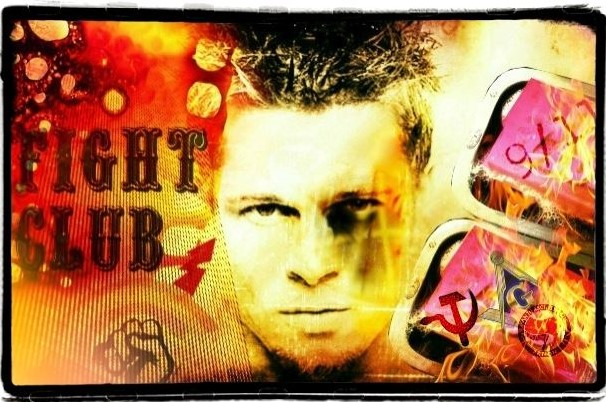
‘SHADOW BOXING’ – Fight Club’s Tyler Durden is emblematic of Sigmund Freud’s ‘death drive’ impulse within the film’s narrator. (Photo Illustration SCH 21WIRE)
The Birth of Fight Club
On a primal level, the film Fight Club is a story about an all-male members only underground fighting ring called “Fight Club.” The secretive fraternity becomes fixed on a potent yet false sense of self-realization that descends into societal mischief to reshape themselves. The mercurial movement later mobilizes against the perceived shackles of postmodern society in a symbolic terror campaign.
The embattled counterculture within Fight Club is seen as a rejection of consumerism through the lens of Karl Marx’s commodity fetishism. While Fight Club has the appearance of being against conformity, looking closer, we see the film’s spotlight on victimhood and social justice, revealing its very own authoritarian prisonscape.
From the outset, the David Fincher directed universe calls to mind Jean Baudrillard’s semiotic ‘copy world’ concept known as hyperreality. This alternative reality set during the film’s opening credits, depicts a high-octane CGI point of view journey inside the inner workings of the human brain. The simulated imagery follows the point of view out of the pores of the film’s narrator, sliding across the top edge of a blurred revolver coming into frame. The graphic sequence begins in medias res or in the midst of things, and may be seen as a reference to the narrator’s own splintered psyche.
Over the years, many Hollywood films have employed an in medias res plot structure to great effect. This technique has been employed in Tinsletown classics such as Citizen Kane (1941), the neo-noir mystery Mulholland Drive (2001) and the inverted dreamscape of Inception (2010), along with many others.
Based in oral tradition, in medias res has been around for centuries and is rooted in a technique exemplified by Homer’s work in the Iliad and The Odyssey. Just as the Trojan War is underway epic poem the Iliad, a series of flashbacks in The Odyssey sees the journey of Odysseus is already over.
One could assert that Fight Club is actually an inversion of the monomyth present in the Iliad and The Odyssey. This is observed when looking closely at the film’s adversarial antagonist Tyler Durden (played by Brad Pitt), who exemplifies the rebel revolutionary archetypal motif that holds dominion over the unnamed narrator (played by Edward Norton). Additionally, Tyler embodies a pseudo-philosophical persona that might be considered a postmodern misinterpretation of Friedrich Nietzsche.
In a much deeper underlying aspect, Fight Club represents a postmodern interpretation of allegorical myth and secret societies of the initiated. The Gnostic demiurge exemplified by its antagonist Tyler, contains with it, loose elements of Eleusinian cult’s ritualistic practices and aspects of the Ancient Mystery School. On the whole, several scenes throughout Fight Club depict occult imagery, specifically symbols commonly linked to Freemasonry. Moreover, the secretive fight club itself appears in many ways to be a nod to mystery tradition and Masonic initiation. Fight Club‘s relation to Freemasonry has drawn attention in recent years, and the masonic-based publication known as The Southern California Research Lodge wrote a piece about the similarities.
Perhaps lesser known, is the story’s inference to the secretive communist League of the Just. The League of the Just would later evolve into The Communist League, a group shrouded in claims of secret society connections.
 As Fight Club progresses, we see that Tyler has emerged from the narrator’s unconscious mind. This aspect of the story immediately recalls the archetypal analysis of Carl Jung’s Psychology of the Unconscious. Tyler is the daemonic shadow of the narrator’s psyche, and later the viewing audience will discover the leader’s role as a Psychopomp within the fight club construct. Thus, Tyler’s underground fight club is in reality a ritual initiation and in deeper sense could be seen as a descent into the rungs of the underworld.
In Meeting the Shadow by Connie Zweig and Jeremiah Abrams, we see a concise interpretation of Jung’s shadow concept:
“The shadow goes by many familiar names: the disowned self, the lower self, the dark twin or brother in bible and myth, the double, repressed self, alter ego, id. When we come face-to-face with our darker side, we use metaphors to describe these shadow encounters: meeting our demons, wrestling with the devil, descent to the underworld, dark night of the soul, midlife crisis.”
One could contend that the passage from Meeting the Shadow above accurately describes Fight Club‘s chief alter ego, Tyler Durden.
As a representation of the shadow mind, Tyler is antithetical to the hero myth. We can see that Tyler’s story arc and that of the narrator, is a postmodern inversion of many of Joseph Campbell’s hero’s journey phases.
Similarly, Fight Club appears to reflect the mythos of Dante Alighieri’s 14th-century epic poem the Divine Comedy. The hellish origins of Fight Club illustrate a deeper more esoteric ritual that conjures Dante’s journey through the 9 circles of hell. Tyler is a trickster, a paradoxical guide offering no true pathway to self as his self-absorbed quest in Fight Club betrays Vergil’s guided lessons of hell. Tyler wholly embraces perdition and so to does the narrator by proxy, whose life loses all morality with no real way to traverse towards inner peace (paradise). Fight Club‘s darkly comedic presentation masks this underlying allegory seen throughout its color saturated frames.
Tyler presents Fight Club’s narrator with a Faustian bargain, one where violent revolution supersedes moral reason.
Over the years, there have been many interpretations concerning the true nature of Fight Club. At jackdurden.com, an artful analysis contends that the film‘s characters are merely an elaborate figment of the narrator‘s fractured mind. Although this theory is intriguing, in order for clarity in this article, we’ll keep descriptions concerning the narrator separate from any alternate identities.
Fight Club has many overarching prefigured themes and sociopolitical underpinnings, in addition to its historical connections…
Marxist Mobs, Project Mayhem & The Cultural Revolution
 As Fight Club‘s narrator begins to unravel, Tyler is exposed as a confidence man, a diabolically selfish alter of the narrator. The rebel leader then becomes a symbol of the hive-mind fascist cult organization known as Project Mayhem – a group arguably spawned from neo-Marxist pedagogy.
Project Mayhem is born out of basement brawls and anarchic mischief that is later spurned towards more violent and nihilistic political activism. New recruits of Project Mayhem aka “Space Monkeys” are groomed to participate in mob action under the direction of their spurious legion. As Fight Club develops, Project Mayhem emerges as an anti-corporate, anti-consumer paramilitary-style group meant to topple modern civilization. The group becomes emblematic of many real-life insurrection groups from the 20th century – but we’ll get to that into that later.
Throughout history, the roots of Marxism and Nazism have appeared to be opposites of the political spectrum. However, these political factions have both eroded individualism and subvert cultural traditions since their inception…
 The blurry lines of fascism and Marxism may have its origins in Giovanni Gentile, a neo-Hegalian idealist philosopher, and member of the Fascist Grand Council. The Italian Senator was also the Minister of Public Education for the government of Benito Mussolini. Gentile advocated that society and the state should be one and that a centralized government apparatus oversees its activities. Additionally, Gentile envisioned socialism forming out of revolutionary conflict. This concept overlapped with the main tenet of radical Russian revolutionary Leon Trotsky’s (see left photo) Marxist-fascist theory of perpetual world-wide revolt called Trotskyism. Trotsky was a member of the revolutionary Marxist faction the Bolsheviks founded by Valdimir Lenin and was deeply connected to Freemasonry. The Russian Communist Party founder Lenin, studied and translated the 1848 political pamphlet known as The Communist Manifesto by Marx and Friedrich Engels. This led to the founding of revolutionary cells within Russia and to the establishment of Marxist orthodoxy. This would inevitably set the stage for Joseph Stalin’s rise to power and brutal tyrannical reign. Under Stalin, Russia would see the ‘unnatural deaths’ of millions, many of whom died of forced starvation.
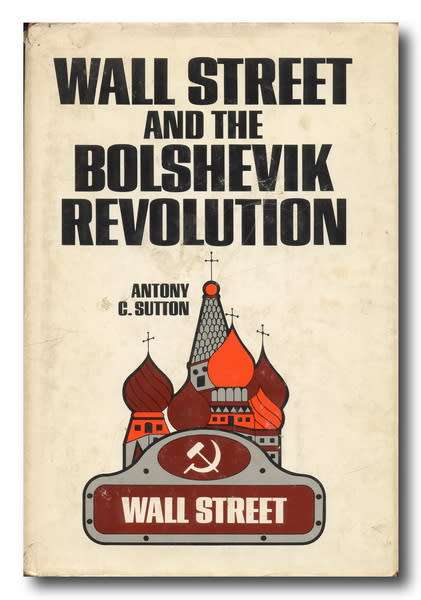 The Bolsheviks were financed by the West and in part by the the well-known Rockefeller family along with other banking barons in Wall Street and London. International cartel capitalists sought to aid in the Russian Communist Party rise, yet despite that, there’s still a perception of capitalist society being against communist society. The truth seems to be much more nuanced and complicated from a historical lens.
In the investigative book Wall Street and the Bolshevik Revolution by Antony C. Sutton, the ruling class in the West was in favor of centralized political and economic power. However, in order to accomplish this goal – they funded a communist revolution.
American oligarchs surreptitiously bankrolled a Marxist revolution in order to gain more political and economic control. This was because of their commercial interest in a postwar Russian financial market. Sutton expands:
“Revolution and international finance are not at all inconsistent if the result of revolution is to establish more centralized authority. International finance prefers to deal with central governments. The last thing the banking community wants is laissez-faire economy and decentralized power because these would disperse power.”
Marxism divided society in two halves and has aimed to abolish private property, nationality, family tradition and religious beliefs.
Through a superstructure and base model of society, Marxism took the shape as an economics-focused system but that wasn’t all. Italian Marxist Antonio Gramsci would go onto develop a Marxist theory known as cultural hegemony which advocated the dominion of society by the ruling class to manipulate cultural norms, behavior and beliefs through social institutions in order to shape a radically different worldview.
 In the book Nihilism: The Root Of The Revolution Of The Modern Age by Eugene (Fr. Seraphim) Rose, we see how China’s Cultural Revolution was created through variants of fascism and Marxism:
“The totalitarian Nihilist regimes of this century have undertaken, as an integral part of their programs, the ruthless “reeducation” of their peoples. Few subjected to this process for any length of time have entirely escaped its influence; in a landscape where A is nightmare, one’s sense of reality and truth inevitably suffers. A subtler “re-education,” quite humane in its means but nonetheless Nihilist in its consequences, has been practiced for some time in the free world, and nowhere more persistently or effectively than in its intellectual center, the academic world.”
In 1966, Chinese revolutionary and Communist Party leader Mao Zedong wrecked society through a carefully planned violent social movement known as the Cultural Revolution. From 1966-1976, Mao’s student-led paramilitary army called the Red Guards, were whipped up into a frenzy, leading to a grotesque wave of mass anarchy. Zedong’s Red Guards then tormented and killed educators, intellectuals and those politically opposed over the course of a long decade.
The Red Guards also saw to it that China descended into Communist control through the systematic targeting of the Four Olds; Old Customs, Old Culture, Old Habits and Old Ideas. When looking back at the savage brutality of the Maoist Red Guards, you can clearly see the revolutionary firebrand of both Marxism and fascism at work.
The academic-based website Owlcation examined the forced labor and re-education used during China’s Cultural Revolution:
“Controlling the minds and thoughts of the Chinese people goes back to the start of communism in the late 1940s. The leader of China’s communist revolution, Mao Zedong, set up a huge network of prisons, called laogai, to isolate those deemed to be troublemakers.”
The Laogai Research Foundation points out that the system “In concept … is rooted in communist revolutionary ideology blended with traditional Chinese views on punishment, namely that anti-social behavior (whether criminal or political in nature) can be ‘reformed’ and eliminated through forced labor and re-education.”
Although packaged in a shiny Hollywood veneer, the film Fight Club was also rampant with themes of radical anarchy and re-education…
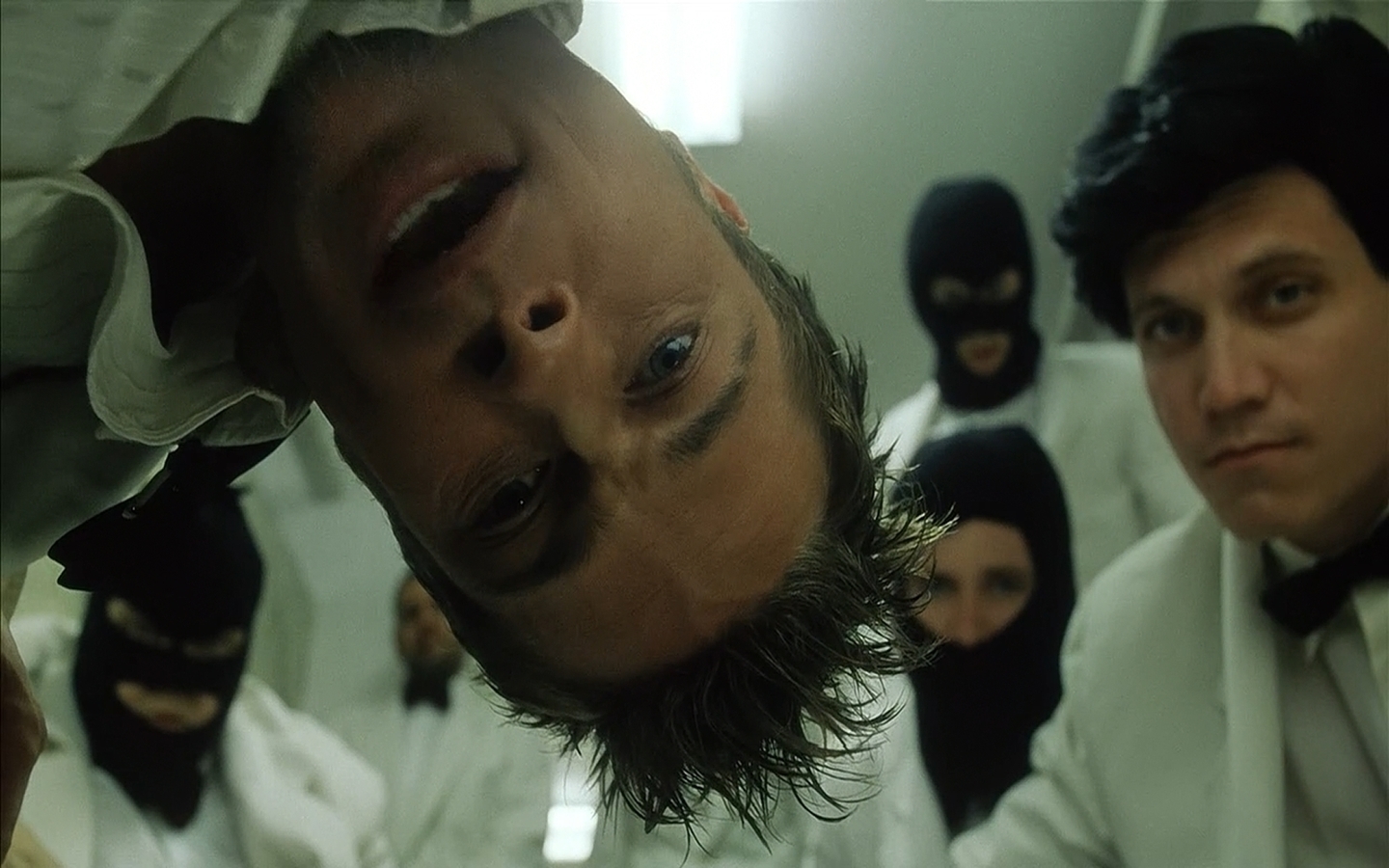
‘CULT CRIME’ – Fight’s Club’s Project Mayhem makes use of black operations and syndicalism to reshape society.
As the black-clad fight club members are further re-educated and hazed into action, we start to see the revolutionary underbelly that runs deep within the cult organization. When new recruits take up position at the dilapidated Victorian-style Paper Street house they graduate to the next level, becoming further entrenched in the next form of sociopolitical upheaval.
“Sooner or later, we all became what Tyler wanted us to be.” – the narrator from Fight Club
From Russia’s Bolshevik Revolution to China’s Cultural Revolution, we can see a fascist-Marxist upheaval reflected in Fight Club‘s anarchy stained scenes featuring Project Mayhem. The film’s “space monkey” provocateurs quest for a Marxist utopia should be seen as a type of color revolution meant to cause the economic destruction of America. Fight Club‘s brand of Marxist insurrection belies at least on the surface, the slow incremental march of Fabianism and neo-liberalism of 20th Century. Instead, the group favors an armed paramilitary terror revolution to propel their modern communist construct.
Fight Club‘s postmodern call to action is wrought with identity politics, class warfare and an underlying false left/right paradigm. In the real world, Project Mayhem would just be another Marxist inspired insurrection group appearing to oppose societal systems of control. The group’s misguided actions would likely enable an existing power structure to gain a foothold over society.
Here’s a scene that depicts Fight Club’s hive mind initiation. Watch how Tyler motivates his ‘brotherhood’ for the coming revolution with a Cultural Marxist diatribe…
In reality, it’s important to remember fascism’s close ties to Marxism, both are political philosophies used to achieve a one-party centrally planned totalitarian government through force and suppression. Within the revisionist halls of academia, the masses have been hoodwinked into thinking The Nazi party (The National Socialist German Worker’s Party) was an extreme right-wing regime. In fact, they were just another variant of socialism. The German National Socialists, along with the Italian Fascists expanded social safety nets and through the National Socialist People’s Welfare (NSV), redirected wealth for social means. In addition, NSV was tasked to head their social engineering programs.
The Mises Institute analyzed the often misunderstood politics of Nazi Germany by addressing its socialist roots:
“Nevertheless, apart from Mises and his readers, practically no one thinks of Nazi Germany as a socialist state. It is far more common to believe that it represented a form of capitalism, which is what the Communists and all other Marxists have claimed.
What Mises identified was that private ownership of the means of production existed in name only under the Nazis and that the actual substance of ownership of the means of production resided in the German government.”
“…what specifically established de facto socialism in Nazi Germany was the introduction of price and wage controls in 1936.”
Although Italy sided with the Nazis at the start of the WW2, Mussolini (said to have been an MI5 agent) would later express praise for Stalin‘s Soviet Union after being fired by the Grand Fascist Council and Italy‘s turn of war against Germany in 1944. Mussolini’s longtime Marxist-fascist beliefs recall the often ignored relationship between Italy’s Fascists and the Soviet Union’s Bolsheviks.
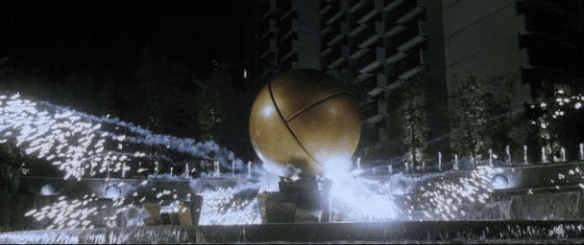
‘ART OF DESTRUCTION’ – Project Mayhem destroy a WTC-like sphere, sending it careening towards a local Starbucks.
The multilayered nature of Fight Club reflects many of the emerging cultural aspects of today’s real politik, much like the film The Purge: Election Year, there are underlying political perspectives that aren’t often broached in many modern films. Both motion pictures prominently feature a modern variant of today’s real world neo-Marxist violent direct action. However, Fight Club more acutely combined both Libertarian Marxism and Anarcho-Marxism.
The film’s militant revolutionary action is geared towards changing societal norms and social institutions.
French anarcho-communist author Daniel Guerin has described libertarian Marxism as the following:
“Modern libertarian marxism, which flowered in May 1968, transcends marxism and anarchism.”
“To call oneself a libertarian marxist today is not to look backwards but to be committed to the future. The libertarian marxist is not an academic but a militant. He is well aware that it is up to him to change the world – no more, no less. History throws him on the brink. Everywhere the hour of the socialist revolution has sounded. Revolution – like landing on the moon – has entered the realm of the immediate and possible. Precise definition of the forms of a socialist society is no longer a utopian scheme. The only utopians are those who close their eyes to these realities.”
From here we can see an underlying system of anti-authoritarian change linked to libertarian Marxism, which does not reject the use of force for social change. In many ways, to be a libertarian Marxist is to seek freedom from all but the state. If we think of this in terms of Fight Club, we see a broader picture of the overlapping aspects of Marxism throughout the film.
If we are to acknowledge the Machiavellian political scope of Fight Club and it’s Project Mayhem menace – viewers are met with another fundamental question: how long before the anarchist-Marxist junta became just another totalitarian regime if they were able to gain control?
We see the violent radicals Antifa and the Black Lives Matter contingent of America capitalizing on today’s disenfranchised cultural milieu. This is similar to the fictional universe of Fight Club’s Project Mayhem groupthink…
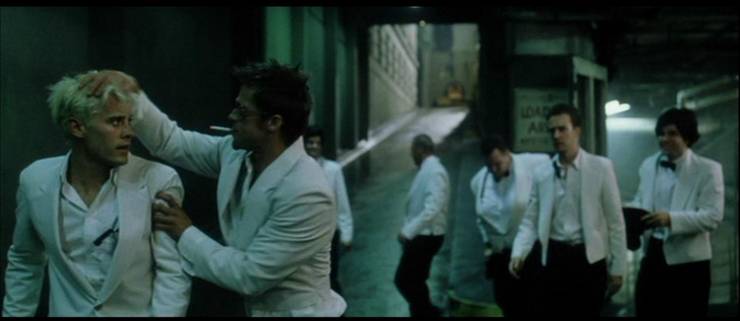
‘MAYHEM MOB’ – Tyler’s Fight Club recruits graduate to a more subversive level of violent activism in Project Mayhem.
Rage Riots: Antifa & BLM
In 2017, America was brewing with tension following the 2016 presidential election of Donald Trump. The choreographed immigration protests backed by George Soros’ Open Society Foundations (OSF) – saw Antifa’s first US ‘riot tour’ which culminated in the Charlottesville riots in Virginia. Then a series of ‘social justice’ protests over Confederate statues, as ‘black bloc‘ instigators launched a destructive riotous campaign to raise their political activist brand in the US.
In 2020, America was besieged by rioters in the aftermath of the death of George Floyd. The transnational insurgency known as Antifa, unleashed a violent wave of riots across America with their revolutionary counterparts from Black Lives Matter (BLM). The Marxist-Leninist groups became synonymous with one another as cities burned across the country.
It should be acknowledged that prior to the death of Floyd, he had a lengthy and violent criminal record that included a felony assault and armed robbery while impersonating a government employee.
Many in American media and the Hollywood celebrity class parroted the same talking points concerning Floyd’s death something which only served to inflame the rage riots of 2020. Virtually almost all major media outlets blindly decried claims of “systemic racism” sweeping across America without any factual basis to produce such a reckless assertion.
In 2020, we saw a chain reaction of events meant to obfuscate reality. Whether it was the media’s unproven claims of systemic racism, the “Casedemic“ surrounding Covid or scapegoating the climate agenda regarding wild fires in California. We’re told that those dangers are ubiquitous and imminent.
In 2012, America was transfixed on the Trayvon Martin-George Zimmerman case. It was a case where mainstream media outlets deliberately fabricated elements in order craft a racially charged narrative without any sufficient evidence to prove such claims. In the end, it would be revealed that the Department of Justice actively fomented social unrest by politically charging the public over racially divisive rhetoric.
Today we see media and political action movements like BLM also invoking race as a primary motive in many cases across the country without looking at the facts.
Vastly misunderstood cases such as the Breonna Taylor police involved shooting have seen mobs turn riotous after not getting the social justice verdict sought. This reinforces the false media narrative of perceived systemic racism, rather than looking at empirical evidence in a particular case.
Following the decision in the Breonna Taylor case, a U-Haul truck supplied BLM members with ready-to-go signs calling for the abolition of the police force.
According to Kentucky Attorney General Daniel Cameron, the officers took gunfire upon entering Taylor’s residence.
Rioters in Louisville had a U-Haul on standby loaded up with supplies, and immediately geared up as soon as the Breonna Taylor decision was announced.
People pretend these riots happen out of nowhere. They don't. They're well-coordinated and prepared. pic.twitter.com/AuTZp1Z57D
— David Hookstead (@dhookstead) September 23, 2020
Back in February of 2020, Hollywood was already seen peddling the systemic racism tagline just months before American cities were set ablaze over alleged police and criminal justice abuse. In fact, Joker star Joaquin Phoenix, discussed alleged racism and how it relates to Hollywood during his acceptance speech at BAFTA – well before the summer of rage riots.
‘I think we send a very clear message to people of color that you’re not welcome here.’ — Joaquin Phoenix went right at Hollywood’s systemic racism in his BAFTAs acceptance speech pic.twitter.com/EUSJzPLUUa
— NowThis (@nowthisnews) February 3, 2020
In early October of 2020, former First Lady Michelle Obama further stoked the flames of racial divide by attempting to reframe the devastating US riots as “overwhelmingly peaceful.” The stylized propaganda video spot presents mainstream media’s familiar Left vs. Right paradigm. The stylized video presented mainstream media’s familiar Left vs. Right paradigm. However, it failed to acknowledge the stark reality of those responsible for the most costly riots in US history.
Watch the former First Lady’s virtue signaling on full display…
In August of 2020, leaked body cam footage of Floyd’s attempted arrest by Minneapolis Police, showed that the alleged racial motivation of the officers appeared to be unfounded. All of this was on the heels of America careening on the edge after scientifically questionable Covid lockdowns caused massive economic ruin and emotional distress.
In the aftermath of Floyd’s death, we still have yet to see clear comprehensive evidence of a racially motivated crime. However, that became the impetus for the burning and looting of many American cities in 2020. After the showtrial for Derek Chauvin, an alternative juror expressed fear for her life if a guilty verdict wasn’t delivered. It was also revealed that Juror 52, known as Brandon Mitchell, was found to have supported BLM at an event in Washington, DC.
The Daily Mail released footage of George Floyd’s encounter with Minneapolis Police – watch closely to see how the event unfolded…
In 2020, the Department of Homeland Security (DHS) and former DOJ Attorney General Bill Barr investigated the funding behind Antifa’s organized violent activities. That investigation has since gone cold.
In 2019, US Senator Bill Cassidy and Ted Cruz introduced a resolution to declare Antifa a domestic terror organization following a vicious attack on journalist Andy Ngo. Yet rather ironically, acting DHS head Chad Wolf outlined that white supremacists are the “most persistent and lethal” internal “threat” to the US. The report came after weeks of political pressure over Wolf’s alleged favorability towards the Trump administration as radical left groups have continued rioting, vandalizing and looting across America. Then FBI director Chris Wray, also concluded that aside from lone wolf terror, white supremacists are the greatest threat to America – but is that really true?
Over this last year, the white supremacy threat has been echoed by other intel agencies and media without any credible evidence.
In October of 2020, several men faced federal charges and state charges in an apparent plot to kidnap Michigan Gov. Gretchen Whitmer before the US presidential elections. The alleged plot was for retaliation over COVID-19 restrictions the Democratic governor enforced on the state. In July of 2021, it was revealed that the FBI played an even bigger role in the Whitmer kidnapping plot then was initially reported. The FBI has a long and sordid history fabricating terror plots in the US.
The political timing of this FBI foiled plot should not be understated as it perfectly fits the FBI’s recent top threat list narrative. Turns out, the media framed militia gone awry were actually entrapped FBI informants used in a sting operation most likely to frame-up American patriots.
Mass media often injects their own formula for laying out a familiar series of polarizing political points in the aftermath of any high profile or ‘tragic’ event. There is often a ready-made laundry list of hateful rhetoric, social media declarations and random writings and photos to be seen as an ironclad motive for a crime. The Michigan militia plot like others before rapidly descended into a barrage of politically motivated theorizing without looking at the real evidence.
There’s been a long history of social upheaval by way of splintered political action groups…
The resurgence of America’s present day inner-city violence caused by Antifa and BLM takes a page from the Nazi party’s Sturmabteilung (SA). The SA was unofficially known as the “brownshirts,” similar to Italy’s fascist “blackshirts,” who were a paramilitary force created to oppose any and all political opponents. The brownshirts consisted of ex-soldiers and Nazi bodyguards who were used in riots who battled other socialist groups for control to overthrow Germany. The SA stormtroopers used brutal force, suppressing free speech, while stifling other nationalist political groups in order to gain a foothold over society.
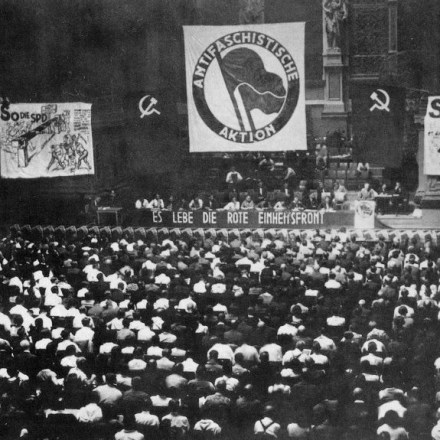 In 1932, the Communist Party of Germany (KPD) formed the militant group Antifaschistische Aktion (Antifa) to oppose other radical socialist groups, including Germany’s Social Democratic Party (SDP). The Anti-fascists were Stalinist’s bent on a brutal Marxist-Leninist ideology that propelled violent revolutionary terror throughout Germany during the declining Weimar Republic. Another wave of Antifa would re-emerge in Germany under the authoritarian-Marxist banner of Autonomism in the early 1980’s. As Antifa has sprung up in America, we could see the group mimic the anarcho-terror in Europe caused by the Red Army Faction and the Red Brigade.
In addition to being inspired by German insurgency groups, Antifa has emerged out of various off-shoot groups such as Anti-Racist Action (ARA), Anti-Fascist Network (MAFN), and the Torch Antifa Network. The roots of ARA can be traced back to the domestic terror group Weather Underground. ARA punks and skinheads were advised by the John Brown Anti-Klan Committee (JBAKC) who fronted the May 19th Communist Organization (MCO). This group was founded from those in other terrorist groups of the ’60s and ’70s such as the Weather Underground, the Black Liberation Army and FALN.
ARA members would later go on to form one of the one of the largest Antifa networks in America. This group is known as Torch Antifa, and according to The Claremont Institute a JBAKC member registered their website.
Under the premise of being an anti-racist organization, JBAKC endorsed bank robberies carried out by the domestic terror group MCO, then later advocated for the expropriation. Four former members of the Weather Underground/MCO were convicted of several bombings and robberies throughout the 1980s. One such robbery, included the 1981 Brinks Armored Car Robbery involving the Black Liberation Army’s Mutulu Shakur, father of Lesane Parish Crooks, deceased rapper, Tupac Shakur.
In 1975, the Weather Underground whose name was inspired by a Bob Dylan song, claimed responsibility for bombing the headquarters of the U.S. State Department in Washington, DC.
In 2013, The Torch Antifa Network became the umbrella network for the supposedly decentralized far-left militant extremist movement in the US. One of the particularly virulent strains of violent extremism from the network is the chapter known as Rose City Antifa. It should be mentioned that Antifa and the Marxist-founders of BLM have openly called the abolition of certain elements of society. In 2020, Project Veritas revealed that Portland’s Rose City Antifa were operating fight club-like training sessions for new recruits.
In recent years, we’ve seen symbolic violence become more incendiary and the pantomime battles of Antifa vs. the Proud Boys, along with the riots of BLM, ushered in an American color revolution.
While much of the extremist activities of Antifa over the past year have been laid bare their apparent rival the Proud Boys, also have a controversial history. Somewhat recently, Proud Boys leader Enrique Tarrio, was revealed to have been an FBI as an informant for the federal agency since at least 2012. Yet even today, he is still acknowledged as the group‘s leader, as the troupe purports to