Select date

How Arabs Revolutionized Western Culture


 By Neenah Payne
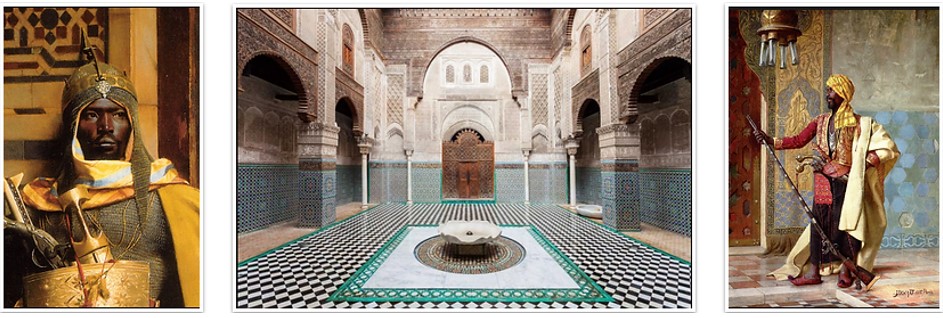
When Moors Rescued Europe From The Dark Ages explains that after the fall of Rome in 500 AD, Europe sank into the Dark Ages where only the clergy was literate. When the Moors ruled Spain from 711-1492 AD, they brought Europe out of the Dark Ages through the establishment of libraries and universities as well as splendid gardens and architecture, cities with paved roads and lighted streets, as well as homes that were heated and air-conditioned.
The Arabs introduced the Arabic numbering system which replaced the awkward Roman numerals. Spain, Portugal, Holland, and Britain became global maritime powers only because of the shipbuilding, navigational skills, and maps they learned from the Moors. Europe got guns and ammunition from the Moors. Had the Arabs not ruled Spain for almost 800 years, Europe might still be in the Dark Ages!
How Muslims Transformed Western Civilization documents how the Arabs jumpstarted the Renaissance through their contact with Sicily. European scholars raced to learn astronomy, philosophy, mathematics, science, technology, medicine, etc. from the Arabs.
However, after acquiring all this knowledge, Europe falsely gave all credit to the ancient Greeks and erased the role of the Moors from history! This was possible because President Jefferson had the Marines defeat the Moors in the Battle of Tripoli in 1804. So, there was no one left on the world stage to tell the true story of Western history. That allowed The Myth of White Supremacy to claim that Europe had invented everything of value in the world and only Europe had contributed anything to civilization. The Myth maintains that all other cultures are backwards and uncivilized.
European and American schools and media mention nothing about the foundational role of the Moors. So, it will come as a huge shock to discuss just how profound and extensive the role of the Arabs was in Western civilization — including in much of the iconic architecture like Notre Dame in Paris, Westminster Abbey in London, and (ironically) the Twin Towers in New York City which the official narrative claims was destroyed by 14 Muslims who drove planes into the towers on 9/11. However, Architects & Engineers for 911 Truth tell a very different story.
This article explains that the role of the Moors was even more profound and extensive than the two articles above showed. It is an endlessly fascinating and important story now as America continues the endless War on Terror on the Arab world in retaliation for their alleged attack on the Twin Towers.
Why America Must Understand The Arab World Now
Julian Assange: “Beat The System” April 8 explains that the US is trying to extradite Australian journalist Julian Assange, founder of WikiLeaks because he exposed some of the many atrocities of the endless 20-year War on Terror which cost America not only financially, but diplomatically. The US wants to try Assange and imprison him for 175 years simply for telling the truth which is the role of a journalist.
Growing BRICS Spells Imminent End of US Dollar, Dollar’s Destruction and Rollout of CBDC, and How Biden Is Destroying America Now explain that China is making friends in the Arab world through its diplomatic initiatives and help in building infrastructure. That is leading a growing number of nations now to abandon the US dollar as the world’s reserve currency and to switch to the BRICS currency which is now the Chinese yuan.
America cannot afford to continue the war with the Arab world. The change in our policy must begin with an understanding of our ignored but historic deep debt to the Moors as shown below.
Even much of the English language has an Arabic origin as shown in Top 50+ English Words—of Arabic Origin! This is a reflection of how much our culture, our way of thinking, and our understanding of the world, our language, math, science, cities, and architecture are shaped by the West’s contact with the Muslim world. These words include: “acrobat, admiral, adobe, alchemy, alcohol, alcove, algebra, algeria, algorithm, alkaline, almanac, amber, apricot, arsenal, artichoke, assassin, average, azimuth, caliber, candy, chemistry, cipher, elixir, french, gauze, gaza, german, guitar, hazard, lapis lazuli, lute, lyes, mafia, mascara, masquerade, mattress, monsoon, mummy, nadir, obama, racquet, ream, safari, salem, sash, satin, soda, spanish, spinach, street fighters, swahili, talcum, tariff, tunisia, watermelon zenith, and zero.”
When Christians First Met Muslims | Prof. Michael Penn
If history matters, then getting right the history of the first encounters of the world’s two largest religions—Christianity and Islam—really matters. In this fascinating video, Prof. Michael Penn, the Teresa Hihn Moore Professor of Religious Studies at Stanford University, sheds light on the extremely important but little-known aspects of the early history of Christian-Muslim encounters.
The House of Wisdom and The Golden Age of Islam
Islamic Golden Age – Philosophy and Humanities
The video points out, “It’s tough to conceive of Western civilization without the contributions of the Muslim philosophers of the Islamic Golden Age.” It explains that the House of Wisdom, a massive library in Bagdad, was the symbol of the Golden Age of Islam traditionally dated from the 8th century to the 13th century.
From Chinese prisoners, Muslims learned how to make paper which was easier to use than velum or parchment. The House of Wisdom was one of the world’s largest assortments of rare books in Persian and Arabic. The House of Wisdom and its contents were destroyed in the Siege of Baghdad in 1258. Its construction and obliteration are viewed as the start and end of the Islamic Golden Age.
Ibn Khaldun (1332-1406), who lived during the Islamic Golden Age, is considered the founder of economics, sociology, demography, and historiography. Much of his work would not see serious development until the 19th century.
The House of Wisdom: How the Arabs Transformed Western Civilization
In this video, Jonathan Lyons, scholar and intellectual historian, addresses the collective amnesia that has left many of us with the unshakeable—if deeply misguided—conviction that the world of Islam and that of the West have nothing in common. Based on Lyons’s book, The House of Wisdom: How the Arabs Transformed Western Civilization (Bloomsbury Press, 2009), which has appeared in a dozen foreign editions, this video tells the story of Adelard of Bath, a 12-century Englishman who travelled to the Muslim world and brought back many of its scientific riches.
Lyons has a doctorate in sociology from Monash University, Melbourne, Australia, and an undergraduate degree from Wesleyan University. Before turning to writing full time in 2007, Lyons served for 21 years as a foreign correspondent, bureau chief, and editor with Reuters news agency, with postings in Moscow, Istanbul, Tehran, Washington, and Jakarta. He lives in British Columbia, Canada, with his wife Michelle Johnson and their dog Ziggy Stardust.
“I have spent much of my professional and personal life exploring the shifting boundaries between East and West, first on both sides of the Cold War divide and, for the past two decades, on the cusp between the Islamic and Western worlds.
Over time, I have come to see the relationships between these seemingly polar fields as a problem not of geography or politics (or even geo-politics) but of thought, ideas, and knowledge – that is, as essential problems of epistemology. Now, I am applying this same insight to the social history of ideas more generally in a new project that poses the question, How do we think about stuff?
My growing engagement with the social bases of knowledge prompted me to leave behind more than 20 years as a foreign correspondent and editor, much of it in the Islamic world, and to complete a doctorate in sociology at Monash University, Melbourne, Australia.
Already, I had begun my journey from agency journalist to author with publication in 2003 of Answering Only to God: Faith and Freedom in 21st-Century Iran, co-authored with Geneive Abdo. My second book, The House of Wisdom: How the Arabs Transformed Western Civilization (2009), presents a narrative account of the West’s extensive borrowing from the medieval Arab and Muslim world. It has since been translated into almost a dozen foreign languages.
Columbia University Press published my third work, Islam Through Western Eyes: From the Crusades to the War on Terrorism, in 2012. This social history of ideas, based on my doctoral dissertation, attempts to explain the fact that Western images of Islam have remained to this day almost unchanged since they were first crafted from wartime propaganda at the time of the First Crusade, one thousand years ago.
I then shifted gears a bit to explore early American intellectual history as a way of uncovering the roots of today’s Digital Nation. America, and by extension much of the modern world, has lost touch with Classical notions of wisdom and mystery. This work traces the trajectory of our national consciousness. I have taught these and related ideas to students at Monash University, George Mason University, and, most recently, at the Center for Muslim-Christian Understanding at Georgetown University. I have lectured around the world and serve as a consultant to Northwestern University-Qatar.
Before beginning doctoral studies, I served as a foreign correspondent for the Reuters news agency, with posts in Moscow, during the collapse of the Soviet Union; in Turkey, during the rise of the first elected Islamist government; and in Tehran during the contentious presidency of Mohammad Khatami. I also worked as a senior editor in Reuters Washington bureau, before taking up my last foreign assignment, in Jakarta in 2006, covering radical Islamic movements across Southeast Asia.
In addition to my doctorate, I have a BA with Honors in Russian and History from Wesleyan University and was a Fellow at Columbia University’s Harriman Institute of Soviet Studies. I also studied at the Pushkin Institute of Russian Language in Moscow.”