Select date

A Hard Look at 5G Wireless Technology … and the Looking Glass of International Protest


 By Peter Tocci
Genuine concerns about 5G wireless telecom/WiFi seem forsaken in protest internationally, while overstatement, misunderstanding, and questionable priorities seem to dominate.
Non-technical reader, please don’t be put off by technical language here. It’s principles we’re after, and those will be made clear. The read is suitable for newbies.
Summary
Introduction: Discusses basics, such as particulars about the signals sent through the air by wireless phones, WiFi and base station antennas, including broadcast frequencies and their designations.
The very important distinction is made, traditionally and still frequently overlooked in “5G” opposition, that “5G” wireless isn’t one thing, but two – based on frequency ranges.
Priorities: Discusses questionable emphasis by activists, even scientists, when conveying the “risks” of commercial wireless systems.
Appeal for a “safe,” or “safer,” or “biologically based” radiation exposure level is ill-advised, futile – and unscientific: “Safe” is impossible to establish with laboratory studies and testing.
Most concerning may be, however, that living things need not be directly irradiated to be harmed and killed by wireless radiation.
Biological effects, All Gs: Discusses the biophysics of specific biological effects and the threat of extreme exposure variability during daily use – or no use.
The radiation isn’t ‘toxic,’ as often said. Effects concern electrical engineering and physics, not chemistry, even though chemical consequences occur.
“5G” Hysteria Review: Various assertions seen and heard since the “Stop 5G!” meme was born are evaluated for cogency/accuracy. The “Stop 5G!” Manifesto-in-Effect (5GM-E) is introduced.
5G: Specific/Potential Threats: With one possible exception, not “5G” frequencies, but new antenna systems, pose the greater threat in both 5G ranges. 5G signals possess the factors that make 2G-4G a persistent, imminently terminal threat to life – in a sense making popular “5G” opposition anticlimactic.
Past, Present, and Future of Wireless: Proof is given that harms were known internationally 2-3 decades before 2G arrived, but deliberately dismissed for nefarious reasons, including a far-reaching surveillance/control-system agenda.
The history and consequences of the context of wireless tech are discussed: Advanced technology per se.
It might be argued that if technociety will not quit all wireless systems at the consumer/use level, we should welcome 5G, since it might shorten the period of extreme agony certain to come from technociety’s long-term, unquestioning, terminally pathological, embrace of phones and WiFi.
Introduction
The radio signal coming to, and emitted by, your phone or other wireless device has electric and magnetic properties – electromagnetic. “EMF” indicates electromagnetic field, which can be stationary. But the term is often used for a field in motion, or electromagnetic radiation (EMR), i.e., the telecom/WiFi signal. It’s also called radio frequency (RF).
Below is a crude representation of a radiated signal. Wavelength is the distance in meters (and fractions) between wave peaks. “Frequency” is the rate at which peaks repeat per second, designated in “Hertz” (Hz). The diagram shows one Hertz, or one cycle, per second.
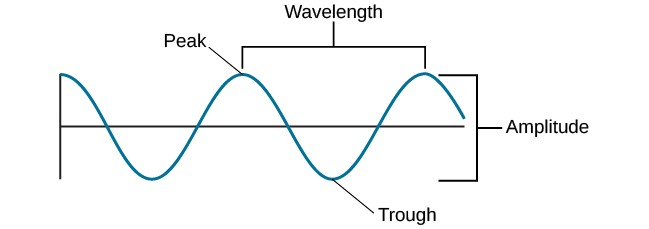
The trough below the line indicates the artificial, continuous wave is polarized, meaning opposing energies – ‘positive’ and ‘negative’ – like a battery or magnet – and alternating. Of paramount importance, polarization occurs as the wave is generated. (Amplitude is intensity.)
Frequency designations are: Up to 999 cycles, Hz is used. One thousand to 999,999, it’s kilohertz KHz. One million to 999,999,999 million, megahertz MHz. For the billions, gigahertz GHz, and THz, trillions. Per second. Staggers the mind.
Frequencies allotted to mobile service providers, such as 1900 MHz (common to AT&T, Verizon and T-Mobile), are called “carrier frequencies”. They carry ‘embedded,’ or encoded, content, but are not themselves the content – also of paramount importance.
Station numbers on AM/FM (KHz/MHz) radios are carrier frequencies. The tuner isolates the desired station carrier from the antenna, and a ‘demodulator’ extracts the embedded content – voice and music.
Telecom/WiFI carriers fall within the ‘microwave’ frequency range, 300 MHz – 300 GHz. Same stuff as in ovens, but different frequencies, and modified. Oven microwave is polarized, though.
Knowing what’s meant/intended by the term ‘5G,’ frequently unspecified in opposition messaging – even in field studies – is essential to meaningful discussion. Also helpful is awareness of dubious assertions informing most protest. We’ll start with the term.
3GPP. The 3rd Generation Partnership Project is a global partnership of standards organizations that develop technical protocols for phones and WiFi. In February 2017, 3GPP issued a “5G NR” (New Radio) international wireless standard/concept, specifying two frequency ranges: 5G NR bands FR1 and 5G NR bands FR2.
Quotation-marked “5G” is used here to indicate unspecified FR. If 5G appears here without quotes and without mlb or mmw, it means common to both. “Content” means all information transmitted wirelessly, from text to video.
FR1 covers traditional telecom/WiFi carriers, most below 6 GHz, including 600 MHz, 1900 MHz, and 2.4 GHz (with at least 2 new ones added to the range for 5G). Collectively, FR1 is called either ‘sub-6 GHz’ or mid-/low-band (MLB). Some tech writers differentiate between mid-band and low-band, but it’s irrelevant here. We’ll call FR1 5Gmlb for accuracy, because the actual range is defined a bit higher than 6, to 7.125 GHz.
FR2 covers “millimeter wave” (MMW), the higher-frequency range added for 5G to the original ‘stable.’ By wavelength, the MMW range is 10 millimeters to 1 mm (c. 30 GHz to c. 300 GHz). But it’s being stretched downward commercially in the US to begin at 24 GHz (even lower elsewhere).
Licensed frequencies in the US for mobile reach 47 GHz, higher for special applications (not mobile – for example, “fixed wireless” Internet). FR2 is designated 5Gmmw.
5Gmmw signals are especially susceptible to attenuation and blocking. There’s some difference of opinion on how susceptible. There’s no doubt, however, their transmission can be compromised by obstacles 5Gmlb barely ‘sees.’
Generally, the higher the frequency, the worse transmission challenge gets. Even leaves and heavy rain can be trouble for MMW (particularly within a certain range of frequencies, as discussed later). Hence, the many antenna installations for instantaneous re-direction. The noted downward stretch could be an attempt at compromise between content-carrying capacity/speed and transmission challenges.
If encountering interference, as in urban settings, MMW beams must be re-routed instantly via the antenna relay system. Signals are even bounced off buildings and other permanent objects. Otherwise, 5Gmmw fails.
Re-routing must involve milliseconds to avoid unacceptable signal delay (latency), something not good at all for autonomous vehicles (a horrible idea anyway).
WiFi still runs mostly in the traditional bands, 2.4 (2.4 – 2.495) GHz and 5 (5.170-5.835) GHz. But in April 2020, FCC opened “6 GHz” (5.925 – 7.125), unlicensed, for WiFi (“6E”), and routers are expensively around. Still basically FR1, though.
Principle: Due to key differences in 5G FR1 and 2, the range/frequency at hand must be noted. Not doing so can lead to misunderstanding, confusion and even unnecessary angst. And it’s used in ‘making cases’ in “5G” opposition.
For example, here’s an article about massive bird die-off when AT&T and USAF conducted a joint exercise. “In August 2020, an AT&T 5G antenna array at White Sands Missile Range went operational…” AT&T owns two 5G frequencies – 850 MHz (MLB) and 39 GHz (MMW). Which was used? We aren’t told.
From the article: The Department of the Interior warned in 2014 about the deadly effects of RF-EMF on birds. http://www.ntia.doc.gov/files/ntia/us_doi_comments.pdf
Research has shown that EMF frequencies affect their navigation and disorient birds. https://kompetenzinitiative.com/wp-content/uploads/2019/08/ki_beesbirdsandmankind_screen.pdf
2014. No 5G in sight. It seems, then, that 8/2020, nasty as it was, is part of a trend? Is blaming it all on “5G” ‘making cases’? Especially when no one knows how compromised by RF exposure, or otherwise weakened, the birds were prior to this incident (predisposition is a major factor, and goes for all living things – even humans