Select date

Towards a New Peace and Multipolar Security Thinking for A Cooperative and Peaceful World


All Global Research articles can be read in 51 languages by activating the Translate Website button below the author’s name.
To receive Global Research’s Daily Newsletter (selected articles), click here.
Click the share button above to email/forward this article to your friends and colleagues. Follow us on Instagram and Twitter and subscribe to our Telegram Channel. Feel free to repost and share widely Global Research articles.
***
Can you imagine a leading economics, finance and investment magazine in the Western world publishing a 30 A4-page (10,000 words) article about the future peace and security world order – a think-piece consisting merely of concepts, theories, visions and philosophical aspects of the theme?
I can’t. They would not see it as meaningful to include perspectives on peace, nonviolence, security and related matters. But they’d probably gladly publish articles about military corporations, profits and the like.
But in China, they see the value of such holistic thinking between interrelated dimensions of society – and of the world – as it really is. Economics is not only about economic things; it takes place in a framework that influences it – past, present and future.
In contrast, the main problem in Western economic thinking is that it’s mostly about market aspects, corporate/private actors and maximising utilities and profits as if economics could be isolated from society and culture. Furthermore, in the academic field called ‘national economics,’ Western economy students spend years learning about something that has not existed for decades in the real world.
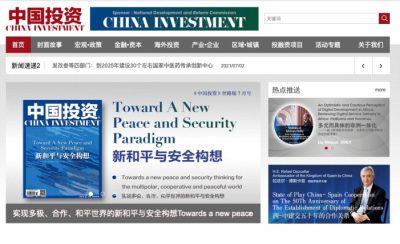
I’m honoured to have been asked by China Investment to write about the theme indicated in the headline. And I am grateful for the opportunity to express my thinking based on four decades of scholarly work, quite some thinking and on-the-ground experiences. See the original edition here.
Before you read my future-oriented analysis, let me quote this from its homepage so you get an impression of the status of this magazine:
“China Investment, founded in 1985, is a monthly under the supervision of the National Development and Reform Commission (NDRC), China’s macro-economic management agency, It’s jointly operated by Investment Research Institute under NDRC, China International Engineering Consulting Corporation. Enjoying an exclusive position under the central government, China Investment is the core journal which started the earliest among similar magazines to focus on the investment trend. Over the past 30-plus years, China Investment has been in line with the global market as its fundamental coordinate with a strategic focus on specific countries and regional markets and those major international propensities. China Investment is a key dialogue platform for officials from different countries, investment agencies, experts and scholars, business people and journalists.”
And now, my article below. It has been changed and re-edited in a few places and I have added some thought on non-military defence.
*
Points of Departure
This article – also a serious invitation to brainstorming and dialogue – is based on these assumptions that I do not discuss per se:
- The West, led by the US and its Empire, is declining on a series of important indicators. When the fall happens, like the Soviet Union about 30 years ago, NATO will disappear too. It cannot be excluded that the EU will then seek to develop its own security system, but it has so far not been able to move itself or the world towards peace – as it should according to its Lisbon Treaty – and its security philosophy is outdated, essentially the same as NATO (which I explain below).
- Since the post-Western world will be multi-cultural and multi-polar – I believe no one will be driven by hubris to the extent the West is trying to convert other societies to be like them and then follow the divide-and-conquer philosophy. No one will feel a God-given mission to propagate one global system in which there can not be unity in diversity. In that future system, a new way of thinking about defence, security and peace will have to build on many and diverse elements, not just one country’s or culture’s way of thinking. And thus, my approach – although alternative within the Western paradigm – is only one part of the story to be told.
- This is an article with a vision – about a new global system of security and not only survival and one that also makes militarism and arms races things of the past and, therefore, the whole system much more peaceful. In the political world of today – in contrast to, say, the art and the science world – there is a fundamental lack of vision, imagination, experimental attitudes, creative thinking about alternatives and new ideas to whatever is.
- In my view, it is impossible to think up and ’design’ a future world order by employing only the tools we know from today’s ”Realpolitik.” It’s necessary to think out of the box, as they say, and not kill any idea with the argument that it is not ’realistic.’ We know today that what once may have been considered ’unrealistic’ suddenly became utterly prevalent. And we know – why else is the old Western, uni-polar order in such decline? – that the old thinking about security, development and peace in reality has brought little of all three and threatens the demise of humankind – either slowly in a ’whimper’ because of the destruction of global nature or with a ’bang’ in a major war, particularly one in which nuclear weapons are used. In other words, Realpolitik is anything but realistic.
- As I have argued over the years, the intellectual disarmament in this particular field over the last few decades – particularly since the end of the First Cold War and reinforced by September 11, 2001, and not the war in Ukraine – is a basic reason for the Western wars and militarism, its intense arms-addiction and the expansion of NATO (1).
- There is, therefore, no time to waste. The global humanity-inclusive dialogue about a fundamentally new way of thinking about conflicts and how to solve them must begin today.
- And we must do it in accordance with the UN’s Charter Article 1 – which states that peace shall be established by peaceful means. There simply is no better normative-intellectual framework than this Charter signed by all the member states – which does not mean that it too must be updated and adapted to the future.
Finally, this article does not offer some models, diagrams of institutions and anything concrete on how to organise the future world, outline big strategies and political action plans. It does not think in linear but more circular terms. That is because the author believes that good ideas coupled with some conceptual-theoretical consistency are eminently practical starters. Thoughts and visions are essentially important for successful change action and policy-making. Too much policy-making, at least in the West, has become (fast) action rather than well-thought, consistent action – and it lacks vision.

Violence, Peace and Security – Differences and Connections
To discuss matters like these in a framework of vision and imagination – it is absolutely necessary to clarify the basic concepts we are going to use throughout this exposé. They are not set in stone, and everyone may criticise or improve on them, but they indicate with some precision the author’s intellectual world and explains how the vision is developed.
Again, all here is an invitation to global dialogue – constructive thinking about a better future and not a criticism only of the present (of which there is more than enough). The complexities of violence, evil and good
It is obvious, but just to have it stated: the overarching goal of all security and defence measures and policies must be to reduce the likelihood/risk that violence will be used by one or more parties against others. Since the risk is greater when there are many violent measures at hand for decision-makers to use – and very few non-violent, civilian means – we must extend it to say that the sheer mass or amount of violent means should be reduced to a minimum needed for purposes we shall later define. Or, as a wise person once said – if you have only hammers in your toolbox, you’re likely to use a hammer to repair anything in the house – and it isn’t rational when, for instance, your wallpaper is coming off.
Why is that so – at least philosophically? Because, in general, violent means that kill and wound – and destroy property and nature – are incompatible with peace. Toxic, killing substances inserted into the human body are also incompatible with health, with few specific exceptions such as cytotoxics against cancer.
How to Define Violence
Secondly, what is violence? One of the absolute authorities on peace research and peace-making is Johan Galtung (born 1930). He defines it as the difference between potential human and societal realisation and the level of de facto human potential realisation – i.e. the difference between what human and their society could achieve and what they actually achieve.
So, it is violence if a father tells his young son who is extremely passionate and clever at playing the piano, that he must become an engineer or dentist. The technical and artistic potentials of the boy are reduced virtually to zero – and he may well live a life in boredom and unhappiness thanks to his father’s violent demand (not advice). Or, when everybody on earth could go well-fed to bed every night but millions are starving, it is clearly violence: the realisation of the potentials of the earth to feed everybody are under-utilised and creates suffering and eventually death. Gandhi expressed it more poetically: ”There is enough on this earth for everybody’s need, but not for everyone’s greed.”
A world that legitimises greed, personal profit and maximising individual utility is a society that is likely to become greed-oriented and cause violence to the disadvantaged because it is not needs-oriented.
So, violence can be seen as the gap between imagined or full potentials of society and individuals and their actual realisation. Spending billions of dollars on warfare in a society where the basic needs of millions of people are not satisfied is a tragic example of violence.
Are Humans Evil or Good – And What Role Does the Answer Play?
One often hears people say that we have wars because humans are evil or aggressive – indeed, born with a capacity for violence. There may be some truth to that – humans are the only creatures that have developed weapons that can kill all of their own species – and threaten to do so regularly. And when we see what humans can do to each other in wars, we wonder with the deepest of concerns: How can some of our own kin be so cruel to other human beings? How can they also sometimes destroy what is humankind’s common (UNESCO) cultural heritage – as, say, in Eastern Aleppo some years ago?
It is quite typical that this argument is advanced by people who a) want to promote certain wars to fight ’evil’ as they say, b) do not have much creativity and knowledge, or c) may be generally pessimistic about the fate of humanity.
First of all, it is absolutely obvious that human beings, if evil, also have a capacity for doing good – loving their children, helping each other, care for the ill and weak, give humanitarian aid – and loving their family members. So why this frequent argument about people being evil – and only that? When giving lectures, I have often been asked: But, Jan, don’t you think there is so much violence in the world because we humans are evil? My answer, with a smile, has always been: Are you yourself evil? And no one ever said: Yes, I know I am!
So my hunch is that ’those evil guys’ are always ’the others,’ not us, not humanity as such. The question is, where this evil nature is rooted? The argument would be that we know this from psychology – for instance, Milgram’s Experiment, from studying personalities like, say, Adolf Hitler – or that we have instinct and operate on them, basically like animals (ethology, animal psychology). One central concept in all these theories is aggression – hostile, violent behaviour and attitudes that, if inner tension builds up, can explode in attack. Aggression is a concept we find not only in psychology but also in international politics and law. There, aggression is not an explainer, it’s a crime.
I think a more fruitful approach is to say that human behaviour has at least as much to do with the system in which they operate as with human nature as such – which I believe also fits Galtung’s definition of violence above. If we organise a military and bring young men into an extended period of education and training to follow the orders of their superiors and kill when told to, it is quite likely that these young men shall actually be able to kill if they fight in a war zone. But does it mean that, by their nature – by human nature – they are evil?
Could it be that systems can be good and evil too – depending on what purposes they serve, how they socialise people into functioning and perform duties in them?
In my view, there is far too much talk about the evil of people and too little about the goodness of people – and there is far too much talk of evil being rooted in individual human nature and far too little about the role of good and evil system and what mechanisms they use to cultivate good and evil behaviour.
We are touching here upon something most enigmatic – existentially enigmatic – about humankind and its existence. Regrettably, there is much too little peace research and other research devoted to these issues – and thousands of times more research funding available to produce new doctrines and weapons that stimulate even more cruelty to more fellow human beings. And they are all backed up by assumptions about the inherently evil or destructive nature of us all.
That could well be called fake – because it is always other people who are evil and, thus, it is not a genuine theory about all human beings. Secondly, it is based on omission – the omission of all mention of the good dimensions of human nature.
Types of Violence
Finally, what types of violence can we think of? There is the physical, direct person-to-person violence: A punches B’s face or kills his family. But there are also psychological violence – humiliating, smearing, deceiving, lying to and about, threatening, uses of psychological warfare among states, demonisation, calling someone evil and using bad names, accusations, projections of one’s own dark sides onto others, etc.
Two things characterise both of them: a) there is a clear sender and a receiver, b) both the physical and the psychological violence tend to create traumas, and traumas may either become permanent and distort the traumatised person’s life forever or lead to hatred and wishes of revenge – often worse than the first perpetrator’s violence: You made me a victim by killing three in my family, I want to get even by killing ten on your side.
There is a theory about the urge to repeat: I/we must – or have a right to – do to others what was done to us.
As an aside, while perhaps understandable, victim violence often has a particularly nasty and complex character because being a victim offers a kind of license to do evil/violence while also demanding sympathy with the perpetrator because of s/he being a victim.
Can anything stop such vicious circles? Yes, a determination to forgive the perpetrator – which is a one-sided action not dependent on the perpetrator’s admission. Secondly, both parties can move in the direction of reconciliation, truth commissions and other healing initiatives; that is a two-sided process, reaching out to each other.
So much for direct actor-to-actor violence – physical as well as psychological.
But there is another fundamentally important, general type of violence – often overlooked in the Western individualist cultural setting – namely that of system or ’structural’ violence – again a term developed by Johan Galtung.
Here we face violence that is built into the modes of operation of a whole system – where the system is the perpetrator of violence, not some identifiable individual actor – human being or state. If one man regularly beats his wife, we would probably say that it is individual physical or psychological violence. But if a system – ’systematically’ – gives all men all the rights over women, we’d say that it is structurally violent, namely what is built into patriarchy – a social system in which positions of dominance and privilege are primarily decided and held by men.
Image: AI-generated image of peace

The same would apply to social phenomena like global maldevelopment, militarism and warfare, imperialism, etc. They are structures in which, of course, individuals do their job and perform their roles in producing violence, but the sum total of these actions is violence to others – people, cultures, countries or the world – that cannot be stopped by, say, arresting a few individual perpetrators. There is not a single individual who, if punished, would cause the violence to go away.
The Cold War idea supported by armament and operated by the MIMAC – the Military-Industrial-Media-Academic Complex – can be seen as such a fundamentally violent structure. It remains more or less permanently violent because, even if the foundation or raison d’etre of it disappears, it will quickly find another reason to exist. That’s what happened, for instance, when the Soviet Union and the Warsaw Pact disappeared about 30 years ago; NATO’s militarism continued unabated – rapidly finding some other threats or ’challenges’ to legitimate its ongoing system violence – at the moment of course Russia, North Korea, Iran and China.
So, while one soldier killing another soldier or killing some civilians on the battlefield is definitely individual violence, they are part of a war and militarism system that is infinitely larger and operating through system characteristics that are not dependent on the individual but on the group/larger systems functions in which we cannot point to one or a few people being responsible. The systemkills, is meant to and operates accordingly.
Before we end this discussion of types of violence, let’s state two classical dimensions of them all: first, there are both visible and less visible aspects of violence, and there is latent and manifest violence. We should learn how to detect the less visible manifestations and catch violence already when it is latent and not when it has broken out. Again, a flue is easier to combat at the early stage than when it has settled more seriously into our bodies.
The other dimension is that if invisible conflicts and violence explode, it will tend to take people with greater surprise and make them react to it less cautiously. That is why ’early warning’ and violence-prevention must be an integral part of a future security and peace system: What will be the consequences of this and that decision and how do we prevent its implementation from creating new violence-prone conflicts?
Finally, it is often meaningless to talk about reforming a system by educating individuals to act differently. You’ve got to address, instead, the violent characteristics of the system mode itself. Global poverty or illiteracy cannot be addressed by individual justice because there are not one or a few individuals who commit those crimes. The global economic system continues the crimes, and to change it, we shall have to think up a more peaceful system and not think of punishing some individuals. That is, there is a need not only for problem definition, diagnosis and prognosis. To change, there has also to be a vision – a vision about fundamentally different ways of thinking and organising an effective system that is oriented towards human, global and environmental betterment.
Necessary Elements of Positive Peace: Securing Development and Developing Security
Everybody says they want peace, but we know very-very little about what it is and how to achieve it. Since it is perceived as a positive value, some organisations will claim as a standard that whatever they do, it is for peace or will bring peace. NATO, for instance, was set up to serve peace, peace is essential in its treaty, and no matter what policy NATO decides to pursue, it is done with the accompanying mantra that it is for ’security, stability and peace.’
Tragically, having promoted peace this way since 1949 and consumed trillions of taxpayers’ dollars has ended us all in this world with the prospect of global, perhaps even nuclear, war. (1)
It’s a common belief that peace can be defined by a system in which no violence and no warfare can be discerned. In the media and policy world, they say that there is peace somewhere because a military struggle has come to an end, and a negotiated solution was found. In most cases, that is just non-war, it is not peace and peace negotiations are often little more than ceasefire agreements – lacking an element of genuine, sustainable conflict resolution – for which reason the same conflict blows up again a little down the road.
Probably, the general public would associate the word ’peace’ with some kind of harmony, inner peace, a dove, a sign, John Lennon’s ”Imagine,” well-being, meditation, feeling one with the universe, love, some inner spirituality, etc. – or the absence of differences and conflicts in a society. Some think it is a composite of other positive values or concepts such as justice, respect for human rights, freedom, democracy, etc. And yet others associate peace with death and dying – RIP, Rest In Peace, they say.
That’s all wrong – and a sign that our world still suffers from a certain peace and conflict illiteracy.
Of course, there is not one single correct definition of peace. Like many other societal qualities, peace is among what philosophers have called an ’essentially contested concept,’ and there will always be debates around both their definition and their implementation. And that is desirable.
A first approximation to what peace is: It is not just the absence of something else, and it is not an amalgamation of other good values. It is also not passivity or a situation where nothing happens – like seeing the sun going down while holding the hand of a loved one. That may, of course, be nice – but peace is something rather different.
It is something in and of itself, something that is dynamic, activity-based and never-ending.
In a culture of militarism, peace tends to be considered a phenomenon deprived of inherent., manifest value – a residual or even a void. What we are trying to get across is that peace is not merely the opposite of war; it’s the never-ending search for ways to reduce all types of violence.
Since violence is always related to some kind of conflict – there are conflicts that don’t get violent but there is no violence without conflict – we must learn to handle conflicts in intelligent, non-violent ways and not by threatening, demonising and fighting wars.
If a basic defining element of peace is the reduction of violence, there is no way the maximisation of the means of violence can ever lead to peace, true peace.
Therefore the dominant means of conflict resolution must be peaceful – exactly as embodied in the entire underlying philosophy and values embedded in the UN Charter. Only as a last resort, when everything peaceful has been tried and found in vain, shall the world community – the UN – come together and use violence under the command of the UN. It’s the most Gandhian document governments have ever signed – implementing, whether knowingly or not, Gandhi’s famous dictum that the means are ”the goals in the making.”
That said, Galtung coined the terms negative and positive peace. Negative peace is the absence of various types of violence – in the same way that negative health means that I am not ill, don’t feel any pains or have a high temperature.
Positive peace is the presence of some qualities that care for the realisation of potentials and opportunities, the satisfaction of not only basic but also higher needs and constantly seeking improvement, a never-ending process. It can be seen as parallel to positive health – feeling energetic, taking on new challenges, exuding conviviality, open for cooperation and helpful to others – everything that is beyond the ”0” on the scale at which we are not only not ill but in full dynamic human – and societal – development.
And the word ’development’ signals the next element of a definition of peace – one I have created over the years, and the title of one of my books: ”Peace is to develop security and secure development for the whole human being and for all human beings in their interaction with each other and the global environment based on an ethics of care.”
This, I have come to believe, is a fundamentally important approach to peace – and more than a definition, rather a conceptualisation that will never be finished – like the change towards ever more peaceful lives around the world will never end. Always a space and a time for improvement!
Here are a few explanations around that – broader and deeper – conceptualisation:
All human beings and all societies seek at least two basic things: To develop – realising their potentials and expanding them through, say, education, culture and production and living a better and better life over time. And secondly, to secure that their development will continue in the future and is not threatened from the inside or outside.
To put it crudely: If we do not feel secure that we are alive tomorrow or next week, why should we invest in our own and society’s development? And for society to secure its future, it needs a lot of different human and other resources – and they will not be available if there is no development in a broad sense of ’development.’
The whole human being means exactly that – not just the physical body or the citizen identity but the whole – the inner, the non-material, spiritual, ethical and convivial – human being. And for all human beings implies that there is no peace where development and security is only for the few, or classes that ruthlessly exploit others – internally in each society as well as globally.
No matter how we define them, colonialism’s and imperialism’s mode of operation – fragmentation/splitting, exploitation, marginalisation and racism – as well as the militarism that, among other functions, serve to uphold them – represent fundamental negations of any concept of peace.
Global Ethics of Care
Finally, what could an ethics of care mean? Is there a new global ethics of care? (2)
First of all, in our thinking, we must leave behind two things by now: First, the Christianity-based neighbourhood ethics and most of the individualised Ten Commandments. Why? Because the world is now one society, the consequences of many of our actions are, measured over time, global. We know that from the holistic thinking in ecology and global/ism studies. Everything is related to everything else, if not immediately, then as time goes by – catchword, Gaia.
Secondly, we must leave behind the anthropocentric worldview, namely that Man is the centre of everything and should control every other living creature. We must recognise that we are not above Mother Nature. Instead, we are partners – the only way to conceive of peace with the Creation, with the global environment.
Image: AI-generate image of peace

These are, of course, bits and pieces of global ethics philosophy about which many books have been written. One philosopher among those who have inspired me most is German-American Hans Jonas (1903-1993), who, in his seminal book, ”The Imperative of Responsibility. In Search of An Ethics for the Technological Age,” (1984) advanced a global ethics around the following formulation: ”Act so that the effects of your actions are compatible with the permanence of genuine human life… In your present choices, include the future wholeness of humanity among the objects of your will. We may risk our own lives, but never the survival of humanity.” (3)
Having come this far, let me cut through it all and say that my own reflections over the years have come to emphasise these three elements of a new global ethics of care:
Care for the permanence of existence of present lives: Be humble!
Care for biodiversity: Abstain, appreciate, preserve!
Care for the yet unborn: Empathise, love!
These principles apply whether we talk about environmental destruction (slower) or global war with or without nuclear weapons (faster).
Human beings can take other species into account. Precisely because of our immense technological power, we must be humble and also accept duties – human duties and not only human rights. We have duties vis-a-vis the non-human world, too. In the non-human world, the animals, plants, microorganisms etc, have rights but they cannot articulate them, only humans can. Therefore it is our duty to use imagination and empathy in defining the right these non-human fellow creatures have. Gandhi’s dictum that there are no rights without duties is so much deeper than just demanding one’s individual and collective rights, not to speak of weaponising them politically.
A particularly important object of our ethics is, of course, those not yet born. For too many generations, humanity everywhere has acted as if no one would come after us. We have, by and large, brought the global environment to a point where future generations will have huge problems surviving, if at all.
And we have introduced, kept and increased – not abolished – nuclear weapons, which are incompatible with every kind of global ethics and true peace. Nobody has the right to decide to end project humankind, but everybody has a duty to help reduce that risk to zero.
While these issues deserve much more elaboration and dialogue beyond these pages, woefully little attention is paid to ethics – and certainly not for a nanosecond in today’s political decision-making circles.
Imagine a prime minister telling media people at a press conference that her government abstains from this or that project because it believes in empathising, loving, the needs and welfare of generations of the yet unborn! Imagine that someone responsible would say that I care for the presence of everything living under the blue sky and that care is incompatible with more wars, offensive conventional weapons in general and weapons of mass destruction in particular.
How come we believe we care for anything if we plan to destroy everything once and forever?
In summary, a serious and comprehensive approach to peace – like the one we have only hinted at above – hardly exists anywhere. One, most people are unaware. Two, philosophy and research about true peace across cultures is close to non-existing. Three, politics is devoid of ethical considerations. Four, people in general including, sadly, the peace movement, seem to believe that peace is only what we have called negative peace and do not focus on the substance of positive peace and strategies toward its achievement. Five, in times of decline and rampant militarism – possible militarism to death – peace thinking belongs to a tiny group of dissidents. The discourse has, as I have argued, been disappeared in research, politics and the media. (5)

The Global Short Circuit: Offensive Deterrence and Permanent Insecurity
In today’s world, military security dominates. People in all cultures and countries associate the word ’security’ with ’national security’ and what countries’ military can do. Other countries are demonised and called challenges or threats – against which ’we’ need to secure ourselves.
That in itself is a gross mistake but natural to a militarism culture. It resembles if we thought that our human health was all about pills and injections.
As a matter of fact and philosophy, the entire sector of security has become what is called an iatrogenic disease. According to Wikipedia, ”Iatrogenesis is the causation of a disease, a harmful complication, or other ill effects by any medical activity, including diagnosis, intervention, error, or negligence. First used in this sense in 1924, the term was introduced to sociology in 1976 by Ivan Illic(1926-2002), alleging that industrialised societies impair quality of life by over-medicalising life.
In his path-breaking books such as Tools for Conviviality, Ivan Illich – an Austrian philosopher, sociologist, historian and Roman Catholic priest – actually did much more than that (2). He criticised the way contemporary society created more or less high-tech, elite-run ’radical monopolies’ that – in the name of serving them – deprive people of their own genuinely human activity, rights and independence and turn society into passive mass consumerism – actually a war by elites on citizens in the name of healing and protecting them.
While done in the name of delivering something good, over time these monopolies come to do more harm than good. (4) Let’s now apply that to the field of security politics.
The state/governments argue that if citizens just pay their taxes, they can take what is needed and create ’security’ to protect these citizens. These same governments then manufacture threats and confrontations – and operate offensive defence technologies and policies – which are bound to create tension and make others feel threatened. These others then arms against ’us’ and our governments then require even more money from their citizens.
A concrete argument advanced repeatedly by NATO is that all members must pay at 2% of their GNP to the national military security. This is, of course, splendid anti-intellectual nonsense, but it serves its purpose with people who have particular interests: the size of a national military budget shall neverbe decided by the performance of the country’s overall economic performance; it shall always be based on a serious professional, multi-faceted analysis of the possible civilian and military threats a country is likely to face within a certain period of time.
NATO’s Secretary-General recently announced that 2% was no longer a ceiling but a floor. It must go higher because of the threats Russia and China represent to the West, he maintains. To put it crudely: NATO exists to protect its citizens against the armament of others that stems from their feeling of insecurity because of NATO’s own offensive, expansive and militarist policies. What is this if not the perfect iatrogenic disease, a perpetuum mobile?
All that is needed is for the stronger to create insecurity in others who then arm themselves and can be designated as enemies of NATO countries. One basic reason this works can be found in the concept of fearology.
Fearology works in two ways: a) Tell your citizens that there are evil forces out there that threaten ‘us’, and they gladly pay to be protected; it does not matter whether in reality there is a threat; it is enough to make them believe there is; b) Make your competitors or adversaries feel that you are strong and can harm them – while simultaneously arguing that you are defensive and have no bad intentions or designs on them.
Image: “Enlightenment Not Nukes” 2023 © Jan Oberg

The main tool to cause such a perpetuum mobile is deterrence – that is, offensive deterrence. Here is how deterrence is defined by ChatGPT, perfectly correctly:
”Deterrence is the use of threats or punishment as a means of preventing or discouraging someone from taking a certain action or engaging in certain behaviour. The purpose of deterrence is to create an expectation of negative consequences for a particular behaviour, which can then dissuade someone from engaging in that behaviour.
Deterrence can take many forms, including the threat of legal consequences, the use of force, economic sanctions, or even social pressure. It is often used in the context of international relations to discourage countries from engaging in hostile actions against one another. Overall, the concept of deterrence is based on the idea that fear of punishment or negative consequences can be a powerful motivator for behaviour change.”
You see the problem immediately: Deterrence is the use of threats and the promise of punishment: if you do not do as we tell you to do or don’t abstain from doing what we do not want you to do.
Deterrence, by definition, can not promote values/goals like confidence, friendship, cooperation, stability, security or peace for both/all sides. When you deter someone, you signal to that someone that ’we see you as a potential enemy, not as a friend.’
It is, therefore, unavoidable that the other feels targeted, insecure, misunderstood or provoked. Such is the – simple – psychology of deterrence. Tragically, it has been and remains the foundational concept of all contemporary security policies and – whether or not it is meant to or just a foolish philosophical short circuit – it will, by definition, never bring mutual or common security, stability, friendship or bring about the UN-stated global goal of general and complete disarmament. And it will also never bring about anything that could meaningfully be called peace.
Adversaries in deterrence mode are like scorpions in a bottle – to borrow pioneering, distinguished US scholar Richard Barnet’s (1929-2004) characterisation of the US and the Soviet Union caught in the First Cold War – a great deal of tension and hostility between the two that are anyhow forced to work together or the stronger finally saying to the weaker: I will now destroy you once and for all since you did not respect my deterrence.
So much for deterrence – now to its offensiveness.
It simply signifies that ’I can kill or harm you on your territory, thousands of kilometres away and with great precision. My security lies in being able to destroy you on your turf.’
Here is Chat GPT’s AI answer, again very correctly informing us: ”Offensive weapons can be defined as any object or device that is designed or adapted to cause harm or injury to a person or property. These weapons are often used in an aggressive or violent manner…(and) are often associated with criminal activity or intent.”
This, of course, excludes empathy with the object of offensive deterrence. Party A declares that it is defensive but has doctrines and weapons, such as intercontinental missiles, that can only be perceived as offensive, threatening and provocative by B – who then increases his long-range arsenals.
Once again, this is intellectually poor but it serves a purpose – the ongoing armament, arms production profits, supra-power politics, being ’second to none’ – in short, the MIMAC mentioned above.
It was never meant to serve security and peace. If a concept of deterrence shall survive at all in the future world order, it must become purely defensive instead. More about that below.
Components of a New Thinking Towards a Future, Peaceful World Order
I believe that if the reader has accepted at least some of the criticism of contemporary security politics and its foundations above, it will be considerably easier to understand how we must change our thinking and what should – and can – be built into the future world peace and security system.
But such a new system cannot just be built on negations of the old. It has to encompass something radically new that will fit the future and not the past.
Its overarching goal is to create a more peaceful world which means a world with much less systemic violence and also much less direct, psychological, gender and cultural violence than today’s system. Like it is the goal of the science of medicine to reduce diseases, it is the goal of peace research to reduce violence and increase potentials for human and societal – indeed global – self-realization and happiness.
However, we need to be pragmatic: there may probably always be some diseases somewhere and new ones appearing we do not know today – and some kinds of violence here and there – and new types emerging. So, the catchwords for the future is violence-prevention and violence-reductionthrough intelligent civilian conflict resolution methods.
But it is not to abolish conflict!
Conflict – Early Warning, Management and Resolution
A conflict is an incompatibility of, say, values, visions, goals and positioning in ranking systems. There will always be conflicts, differences, and disagreements in any human social system. A society without conflict would be a society of brainwashed people who had no capacity or freedom to think and feel, a dictatorship and an extremely boring and inhuman phenomenon.
As a matter of fact, although we may feel it is unpleasant with some inner tension when conflicts appear, conflicts can be seen as something positive: they make us think and re-think on what we do, how we see the other and how the other sees us and how we have seen ourselves (perhaps wrongly). They force us to prioritise among our choices, and if we somehow solve the conflict with the other, we may have learned something important about the issue, the other and ourselves.
In addition, conflicts – which are nothing but problems that stand between the parties – require creativity to be solved. And they demand humanity and empathy also in case the best solution for the conflicting parties turns out to be that they split or divorce and live, instead, as respectful neighbours.
So we can now add a new dimension to the definition of peace: Peace is not to abolish conflict; it is to be aware of them as soon as possible (address them when latent) and deal constructively with them so that the end result incurs as little violence and dissatisfaction among all the parties as possible.
Violence, in contrast, often appears because conflicts – and the concerns of one or more parties – have been ignored, because the resolution once found was wrong and unsustainable or because one or more parties deliberately cheated – which can easily happen in a-symmetrical conflicts – and led to new conflicts.
So a new world system with its tremendous multi-dimensional and multi-polar diversity must have a completely different attitude to conflicts and their management – one that aims at dealing with them early when they are not so serious or have festered – again, like we know very well from medicine.
It’s a natural law that the earlier we address a problem, the easier it is to solve it.
Image: Missile Position 2014 © Jan Oberg

The comparatively best global conflict-resolution institution we have today is the United Nations – not for its operations or bureaucracy but mainly for its Charter. Until the world comes together and reforms the UN, the Charter is by far the best violence-reducing and conflict-resolving normative framework. That doesn’t mean that it is perfect.
As regional and other organisations grow stronger – BRICS, ASEAN, SCO, AU etc – they must be geared to become conflict managers among their own members and thereby relieve the world community from handling all disputes.
It is not easy to outline the system of violence prevention and conflict resolution in any details. But the future is not a world government, it is a dynamic, diverse, networking global governance, early warning about risks of violence and war and early intervention by mediating institutions equipped with the best intellectual and professional conflict-management methods and tools.
It means ministries of peace, widely practised peace education at different educational levels, it means the use of peace-making expertise and peace- and not only war-oriented journalism.
It means a change towards a globally nurturing peace culture – in other words, peace built from the top-down and bottom-up as well as into all kinds of interactions crisscrossing the global human community.
And it means the struggle to constantly reduce various kinds of violence – and the end of militarism and prevention of its return.
All this is possible – if we make the right diagnosis of the present malaise and are willing to begin an honest exploration and global dialogue instead of killing all constructive ideas and thoughts with the manifestly narrow-minded and visionless words: ’But that is not realistic.’
Peace First – Through Common Security
What is lacking in the present – peace-immature and therefore peace-preventing – system is the mature value of community or communality: Common security.
Today’s security, as we have illustrated, is built on zero-sum thinking and on the deterrence idea that country A feels secure by being able to harm or destroy country B. And on the – perverse – idea that military security has priority – must be satisfied first – and then peace will follow more or less automatically. We now know that it won’t, indeed why theoretically it can’t.
The solution to that problem is logically simple: Make peace first and then back it up by intelligent security measures that genuinely support and preserve the peace – the conflict-resolution – achieved. Do not build military-dominated ’s