Select date

Hegel and the Fourth Political Theory


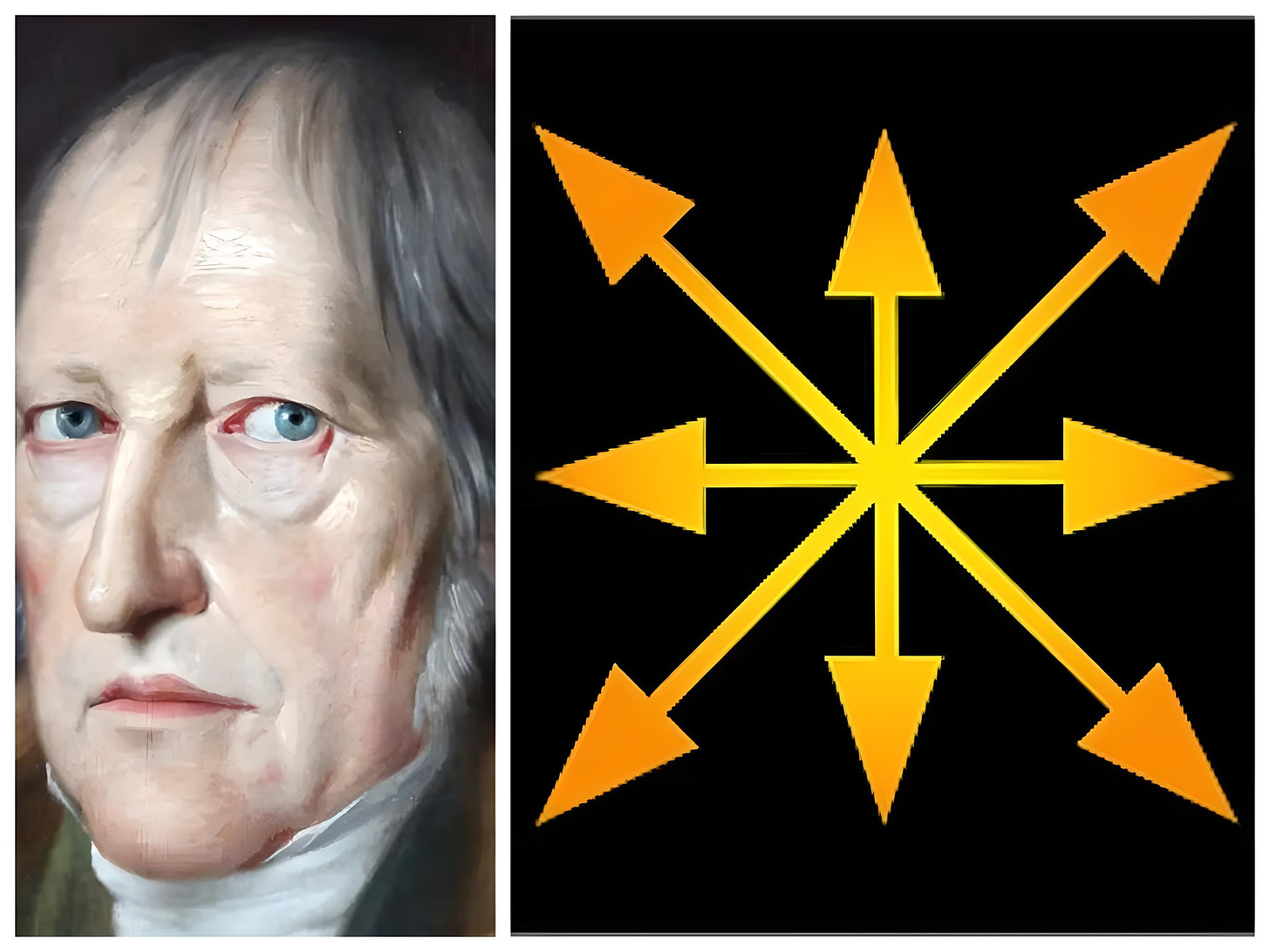
The interpretation of Hegel within the context of the Third Political Theory was much closer to the original. Specifically, Hegelianism was foundational to the political theory of Italian Fascism. Giovanni Gentile, a Hegelian, was the principal ideologue of Mussolini’s regime. In this case, the doctrine of the state acquired its own ontology. Fascist theory recognized the necessity of overcoming civil society in favour of a political nation. The Roman symbol of the lictor’s fasces, representing a bundle of rods, i.e., solidarity and unity of different strata of Roman society, symbolised this new state.
However, capitalism during the Fascist twenty-year period (Ventennio) was not overcome. Fascism continued the tradition of Risorgimento, started by liberal-left nationalists such as the Jacobin Mazzini and practically implemented by the liberal monarchist Camillo Cavour. The idea was to build a unified state in Italy based on disjointed political entities, principalities, autonomies, etc.
In Fascism and Gentile’s theory, these tendencies reached their culmination and, in the spirit of Hegel, transformed into overcoming civil society and creating a corporate state.
However, Hegel’s main idea was the conscious establishment of a constitutional monarchy by civil society through overcoming itself. The monarchy was a principal moment here, as the singular monarch occupied the top of the hierarchical state, replacing the liberal triad of powers — judicial power. Hegel — in the spirit of Cicero — believed that in a real state all three political forms of power identified by Aristotle should be present:
- Monarchy (the power of one, in which the Spirit is personified),
- Aristocracy (which he associated with the government and executive power), and
- Polity (represented by the parliament).
Hegel understood the constitution as the expression of the conscious historical will of civil society to freely and thoughtfully establish a monarchical principle above itself. The monarchy is specifically established, not merely preserved.
In Italy, the role of King Victor Emmanuel II was maintained out of inertia and was not burdened with any content. True power lay in the hands of Benito Mussolini, whose role was not dogmatically and constitutionally clearly defined.
Meanwhile, Fascist Italy largely retained the structures of economic capitalism and individualistic notions about the nature of man, characteristic of civil society. Hence, after the American occupation, the Italians easily reverted to the liberal paradigm. Italians never became a people in the Hegelian sense; bourgeois relations were preserved, and after 1945, they became dominant again.
Where bourgeois nationalism comes into play, which does not ascend to constitutional monarchy, and especially biological racism, which completely negates the moral nature of the state (a fundamental aspect for Hegel), the deviation from the Hegelian system becomes even more apparent.
In Germany in the 1920s and 30s, a school of Hegelians also developed, interpreting Hegel’s doctrine in the spirit of the Third Political Theory — Julius Binder, Karl Larenz, Gerhard Dulckeit. But the National Socialists’ turn to ‘race’ distorted the coherence of Hegelian thought, which conceptualized the people (Volk) without any reference to biology or genetics, as the people were, according to Hegel, a moment of self-awareness of the Spirit in the realm of morality, where any biological predeterminations were completely and irrevocably sublated. German Hegelians could not have misunderstood this but were forced to adjust their philosophy to the demands of the Nazi leadership.
Meanwhile, the German monarchy, led by Wilhelm II, was abolished during the Weimar Republic and never restored by Hitler after the Nazis came to power. His dictatorial powers and charismatic status as ‘Führer’ did not receive full legal and constitutional development — despite significant theoretical developments in legal and constitutional models by German philosophers, especially Carl Schmitt.
Thus, even in the context of the Third Political Theory, Hegel’s system and his understanding of the state and people were fundamentally distorted.
Our analysis leads to two important conclusions:
- Hegelianism had a significant influence on all three political theories of Western modernity, most notably in the twentieth century;
- However, in each of the three, it was fundamentally distorted, sometimes to the point of unrecognisability.
This is where the reading of Hegel in the context of the Fourth Political Theory should begin.
Such an interpretation could simply be a direct following of Hegel himself, without adapting his theory to any external ideological demands. Liberal and communist interpretations of Hegel should primarily be discarded because neither adequately values the state’s actual spiritual ontology. Instead, they operate either with civil society as such, ending everything with pure individualism (a radical approach that modern globalists have ultimately taken to destroy the family), or with a class-based version, which in practice leads to the same results as liberalism (cultural Marxism, hyper-internationalism). Meanwhile, classic leftists have discarded Stalinism or Maoism, where the state plays a more significant role.
Right Hegelianism is historically closer to Hegel but is diminished, distorted, and not fully developed to logical conclusions. Where bourgeois nationalism comes into play, which does not ascend to constitutional monarchy, and especially biological racism, which completely negates the moral nature of the state (a fundamental aspect for Hegel), the deviation from the Hegelian system becomes even more apparent.
Thus, renouncing all three classical political theories of Western modernity clears our access to the real Hegel — to the authentic and consistently logical Hegel that he was in himself — beyond ideological interpretations.
Thus, the Fourth Political Theory can rely on a pure reading of Hegel and easily discard all distorting interpretations.
At the same time, we have repeatedly emphasised that the subject of the Fourth Political Theory should be considered Heidegger’s Dasein or the people (Volk) in its existential expression. The people not as nations, not as a collection of atomic individuals (and we can add: not as an ecumene of families in the Hegelian sense), but the people as a moment of unfolding self-awareness of the Spirit. Here, Heidegger’s substantial and detailed structure of reading Hegel comes to our aid. Here, the starting point can be the general interpretation of Hegel in the context of Heidegger’s philosophy, but especially the materials for lectures and seminars on Hegel’s ‘Philosophy of Right’, which Heidegger conducted in 1934–35. There, Heidegger actually gives an interpretation of Hegel’s doctrine of the state and law, trying to stay as close to the original as possible and recognising Hegel as the crown of Western European philosophical thought, completing a long journey started by the pre-Socratics, Plato, and Aristotle.
According to Heidegger, the Hegelian state is being (Seyn) in relation to what appears as Dasein, i.e., the people, in turn, being a moment of overcoming (sublation) of civil society. In civil society, realising oneself as an individual immersed in social interactions but acting and existing based on developed rational self-awareness, a person comes to understand his individuality not as freedom but as pure abstraction, and thus, one-sidedness and limitation. Then, the individual makes a conscious, volitional decision to reject this civil identity in favour of Dasein, i.e., the people. And in this very spiritual movement, the people establish (constitute) a constitutional monarchy. In this monarchy, the fundamental-ontological comprehension and expression, the action of being (Seyn), are manifested. Only authentically existing Dasein is capable of creating an authentic (Hegelian) state. Thus, Hegel’s metaphysical state of Spirit receives an existential foundation in the people, understood as Heidegger’s Dasein. Specifically through Heidegger, who can be considered one of the main authors leading to the Fourth Political Theory, we can approach such an interpretation of Hegel, which is excluded as long as we remain within the context of the three conventional ideologies.
It is precisely through Heidegger, considered one of the main authors leading to the Fourth Political Theory, that we can approach such an interpretation of Hegel, which is excluded as long as we remain within the context of the three conventional ideologies.
In this case, the emphasis Hegel himself places on his entire system becomes clear: that true freedom belongs only to the state. This means that serving the state is not a renunciation of freedom but rather a path towards it. Renunciation actually occurs from individualism, which is merely a semblance of freedom and even a dialectical obstacle on the path to it.
Thus, Hegel’s entire system, and especially his ‘Philosophy of Right’, correlates best with the Fourth Political Theory.
Heidegger, reflecting on different aspects of the substantive pole of various moments of society in ‘Philosophy of Right’, comes to a very important hierarchy:
- The subject of abstract law is the person (persona);
- The subject of morality (in Hegel’s Kantian understanding, as freedom from the rigid structures and roles of abstract law) — the individual;
- The subject of the family — the family member, the householder in economics;
- The subject of civil society — the bourgeois, the citizen.
But when it comes to the state and the people, the subject — for the first time! — becomes the human (Mensch). And never before has the nature of man — whose source is precisely freedom (=will) — been fully revealed, only links in the chain leading to man as the goal. A human is fully human only in the people and the state. Before this, we are dealing with the slumber of Spirit, though less deep than in Nature. But still, until the people have manifested themselves — and primarily in the act of establishing a constitutional monarchy — there is no human as such. Not yet. And it is here that Heidegger’s Dasein is located.
Thus, Hegel’s entire system, and especially his ‘Philosophy of Right’, correlates best with the Fourth Political Theory.
The only thing that should be separately mentioned is the organic and spiritual connection of both great thinkers — both Hegel and Heidegger — with the fate and ontology of German history, with the German people and German statehood. This determines their perspective on world history and the identity of other peoples — Western and non-Western. German history is intimately connected not just with Western European Christianity overall but particularly with Protestantism, a branch that regarded Catholicism as historically transcended, while Orthodoxy was largely unrecognized and not seriously contemplated by them. Everything Hegel and Heidegger write directly relates to the German people and the history of Western Europe. This ethnocentrism should simply be taken into account. Through it and with a certain foundation, they move to more general principles. The distinction between German (and formerly Greek, Latin, and broader Western) universalism and general universalism is often overlooked. From an external perspective, especially when considering non-Western civilisations that have been reinterpreted by Traditionalists like René Guénon, and particularly through the lens of Russian history that has moved in parallel, perpendicular, or even opposite directions, the German-centric view of these philosophers appears more relative than they presumed. Hegel was recognised and appreciated by Russian Slavophiles, Russian religious philosophers, and intellectuals of the Russian Silver Age, who suggested applying Hegel’s system to a different civilisation — Russia and its people and state. We have similarly reinterpreted Heidegger, requiring a shift from his Eurocentrism and Germanocentrism to a concept of multiple Daseins. By reassessing this ethnocentric stance, which is also supported by the historical trajectory of Germany after two failed attempts leading to the collapse of its civil society and loss of freedom and sovereignty, we create a more comprehensive model for political analysis within the Fourth Political Theory and the Theory of a Multipolar World.
(translated by Constantin von Hoffmeister)